Is air conditioning maintenance required by law?
No, there's no legal maintenance requirement for an ordinary air conditioning system at home. The only regular check the law requires is a leak check, and that only applies once the refrigerant adds up to 5 tonnes of CO2 equivalent (Article 5, Regulation (EU) 2024/573); a split system with about 1 kilo of R32 comes to 0.675 tonnes, well below that.
What the law does ask for
The refrigerant is what moves the heat around inside your air conditioning. In a split system it's usually an F-gas, a fluorinated greenhouse gas such as R32. The rules for it are in the EU F-gas Regulation, Regulation (EU) 2024/573, which applies directly in the Netherlands. There's no compulsory service in it.
What it does include is a leak check. If a system holds 5 tonnes of CO2 equivalent or more in refrigerant, a certified technician has to check it for leaks. Up to 50 tonnes, that's at least every twelve months, or every two years if it has a leak detection system.
For air conditioning at home, it usually doesn't come to that. The Dutch government itself says the leak check only applies to a limited share of household equipment: systems holding a relatively large amount of refrigerant with a strong greenhouse effect.
In the Netherlands, the Dutch F-gas decree, the Besluit gefluoreerde broeikasgassen en ozonlaagafbrekende stoffen, prohibits breaking these EU rules and sets out the certificate requirements. The Dutch inspectorate, the ILT, enforces them.
WORKED EXAMPLE
Does yours fall under it?
CO2 equivalent is the weight of the refrigerant multiplied by its greenhouse effect, known as the GWP. Which refrigerant your system uses and how much it holds is on the label and in the manual.
1.80 kg R32 × 675
1.215 tonnes CO2 equivalent
5 tonnes From here, the leak check is compulsory.
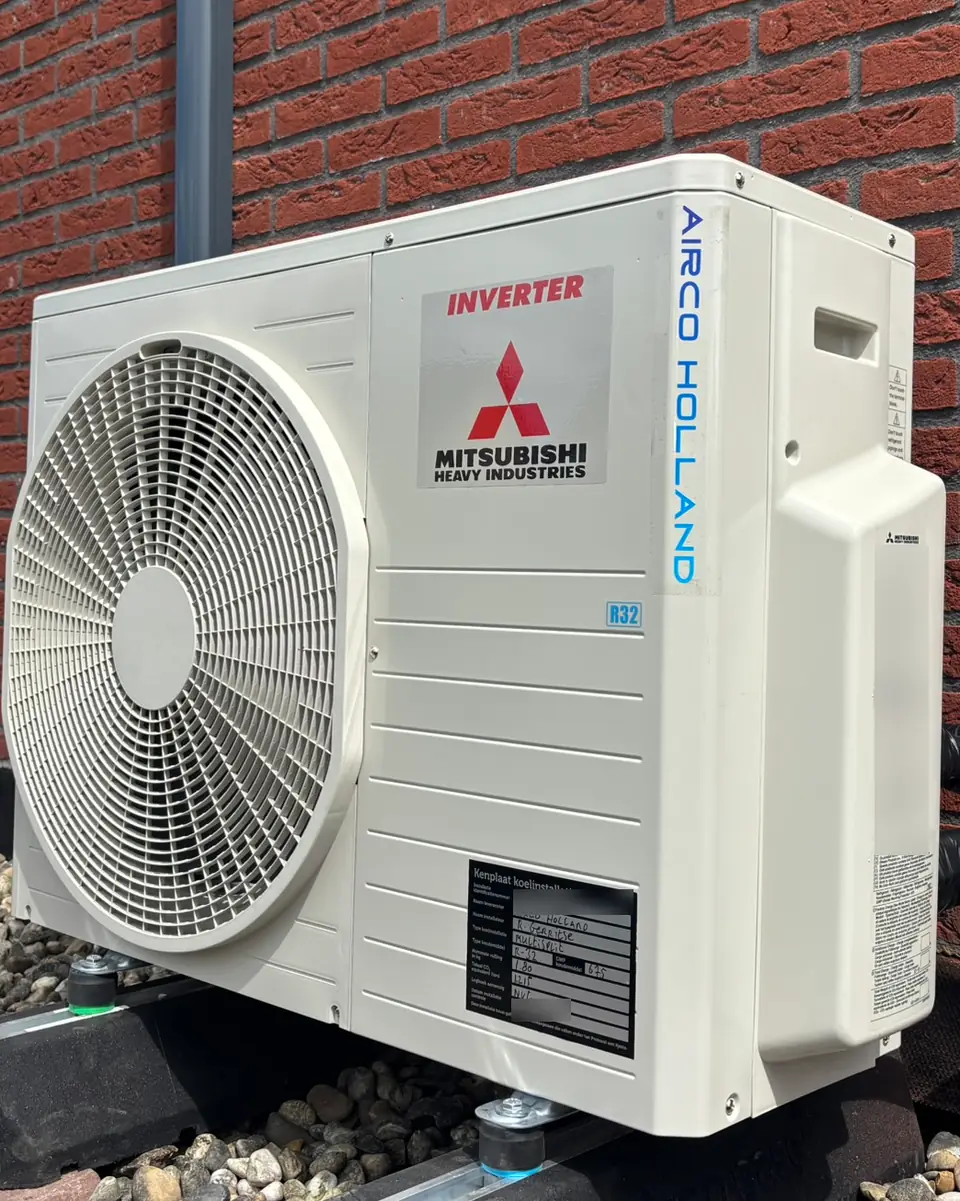
The outdoor unit in the photo: 1.80 kilos of R32 times 675 is 1,215 kilos, so 1.215 tonnes of CO2 equivalent. About a quarter of the threshold.
- R32, used in most split systems sold today: the threshold is at about 7.4 kilos (GWP 675).
- R410A: the threshold is at about 2.4 kilos (GWP 2,088).
The law uses the GWP figures in Annex I of the Regulation; for a blend such as R410A, it's calculated from those. If the label only gives a weight, work it out yourself: kilos times GWP, divided by 1,000, gives you tonnes.
THREE THINGS THAT GET MIXED UP
A service isn't a leak check
The service
The technician cleans your system and checks it over. Sensible, but not a legal requirement.
The leak check
A check of the refrigerant circuit for leaks. Compulsory from 5 tonnes of CO2 equivalent, and only by a certified technician.
Work on the refrigerant
Topping up, fixing a leak, connecting or removing a system. Only a certified technician at a certified company may do it, however small your system is.
What about the 3 kilos?
You sometimes read that a leak check is compulsory from 3 kilos of refrigerant. That was the rule until 2015. Then the 5 tonne CO2 equivalent threshold came in, with an exemption for equipment under 3 kilos until the end of 2016.
When it comes to leak checks, today's Regulation only mentions 3 kilos as an exemption. Hermetically sealed equipment in a home, holding less than 3 kilos and labelled as hermetically sealed, doesn't need leak checks. Hermetically sealed means every part containing refrigerant was sealed at the factory.
What you do have to do as the owner
Servicing isn't compulsory, but that doesn't mean you have no duties. According to the Dutch government, as the owner of an air conditioning system you're usually the ‘operator’ under the Regulation. That means you:
- do what you reasonably can to stop refrigerant leaking out
- have a leak fixed without undue delay once it's found
- only let a certified technician at a certified company work on the refrigerant
- have a certified technician recover the refrigerant before you get rid of the system
Got a large system, for example in a block of flats or a commercial building? Read how the leak check and the logbook work.
Why people have it done anyway
Even the Dutch government writes that there can be ‘other reasons beyond the law’ for wanting a maintenance contract. Milieu Centraal, the independent Dutch information centre on sustainable living, recommends having a split system cleaned regularly so it keeps running efficiently and well, and having it checked for refrigerant leaks.
Check your warranty too. Some manufacturers make servicing a condition, others only for an extended warranty. It's in the warranty terms for your brand.
WHAT THE TECHNICIAN DOES
What happens at a service
With one indoor unit, a service takes about 45 minutes.
- 01
Cleaning
The technician cleans the filters, the indoor unit and the evaporator, and the outdoor unit.
- 02
Checking
They inspect the condensation tray, the fan and the outdoor unit, and check the condensation drain, the airflow and the temperature.
- 03
Telling you what they found
If they spot something that needs extra work, you'll hear what it is and what it costs first. They only go ahead once you've said yes.
If your system falls under the leak check, that's a separate check of the refrigerant circuit, on top of the service.
What you can do yourself
- check the label to see which refrigerant it uses and how much
- keep the outdoor unit clear: don't put anything against it or in front of it
- check the manual to see what the manufacturer lets you clean yourself
- keep the warranty terms and the receipt for every service
What you shouldn't do yourself
- work on the pipes, connections or valves that carry refrigerant
- buy refrigerant, online or anywhere else
- connect a split system
Just look: don't put your hands or anything else inside the unit.
QUESTIONS
What people also ask
What if the label doesn't show the CO2 equivalent?
Then work it out yourself: the number of kilos times the GWP, divided by 1,000. The CO2 equivalent has only had to be on the label since 2017, so it may be missing on an older system.
Does this apply to an owners' association or a business too?
Yes, the rule is the same for everyone and looks at how much refrigerant is in the system. A large shared system can come to more than 5 tonnes, and then the leak check is compulsory. Our page for businesses and owners' associations has more on this.
If the leak check does apply, how often is it needed?
From 5 to 50 tonnes of CO2 equivalent, at least every twelve months, or every two years with a leak detection system. A certified technician does the check, and the results go in a logbook.
Is there an MOT or inspection for air conditioning?
Not for your system at home. The Dutch Buildings Decree only had an inspection for large air conditioning systems over 70 kilowatts, once every five years, and that rule was scrapped on 29 May 2026.
Will my warranty lapse without servicing?
That depends on the brand. Some manufacturers make servicing a condition of their warranty, others only for an extended warranty. It's in the warranty terms for your brand, so keep the receipt for every service.
SOURCES
Where this comes from
- Regulation (EU) 2024/573 on fluorinated greenhouse gasesEUR-Lex
- Besluit gefluoreerde broeikasgassen en ozonlaagafbrekende stoffen (Dutch F-gas decree, in Dutch)wetten.overheid.nl
- Staatsblad 2025, 199, with the explanatory memorandum (in Dutch)Officiële bekendmakingen
- Tips for consumers on servicing and installing air conditioners and heat pumps (in Dutch)ILT
- Air conditioning and fans (in Dutch)Milieu Centraal
- Information for technicians and users of refrigeration, air conditioning and heat pump equipment containing fluorinated greenhouse gasesEuropean Commission
- Regulation (EC) No 842/2006 (repealed)EUR-Lex
- Regulation (EU) No 517/2014 (repealed)EUR-Lex
- Besluit bouwwerken leefomgeving, article 6.37 (repealed on 29 May 2026, in Dutch)wetten.overheid.nl
- Warranty conditions HVAC-R, July 2024 (in Dutch)Panasonic
- Protect your HVAC investment with our product warranty (in Dutch)Daikin
All sources accessed on

WHO ANSWERS
Rein Gerritse
Owner, customer contact and installations
Rein owns Airco Holland together with Peter Reijling. Every article includes what he sees in practice, and he checks it before it goes online.
More about Rein and PeterNot compulsory. But a clean system every year.
With the maintenance plan, the technician comes round every year, we book the appointment and you pay one fixed price a year.
READ NEXT
More servicing questions
How much does air conditioning servicing cost?
Servicing a system with one wall-mounted indoor unit and one outdoor unit costs €199 a year on a plan, or €210 for a one-off service, including VAT. What you pay depends on how many indoor units you have, the type of air conditioning and how dirty it is.
Does air conditioning need topping up every year?
No, the refrigerant in your air conditioning goes round a closed circuit and doesn't get used up. If it needs more, something is leaking or too little was put in at some point, and a certified technician should find out which before topping it up.