Does air conditioning need topping up every year?
No, the refrigerant in your air conditioning goes round a closed circuit and doesn't get used up. If it needs more, something is leaking or too little was put in at some point, and a certified technician should find out which before topping it up.
Refrigerant doesn't run out
The refrigerant in your air conditioning takes in heat and gives it off again. To do that, your system pumps it round and round through the pipes between the indoor and outdoor units, in a closed circuit. None of it gets used up along the way.
If there's too little, it has leaked out somewhere. Or too little went in at some point, for example when the system was installed.
Topping up isn't servicing
If all you ever do is top it up, the leak stays where it is. The refrigerant escapes again, and next year you're back where you started. It's like mopping the floor with the tap still running.
It's bad for the climate, too. R32 is a greenhouse gas: under the Regulation, one kilo that leaks out warms the planet as much as 675 kilos of CO2 over a hundred years. That's why the law also says a leak, once found, has to be fixed without undue delay.
In the legal text, topping up does count as ‘maintenance or servicing’. But it isn't a service: with a leak, it's the last step of the repair. Fix the leak first, then add refrigerant.
Only a certified technician
Topping up, fixing a leak or opening the circuit may only be done by a certified technician who works for a certified company. There's no lower limit: it applies to the smallest system too.
In the Netherlands, that means a BRL 100 certificate for the company and a BRL 200 certificate for the technician. You can look both up in the Centraal Register Techniek, the Dutch register of certified installers.
You also need a certificate to buy refrigerant. The Dutch inspectorate, the ILT, puts it plainly: never buy refrigerant online yourself.
WHERE IT LEAKS
At a pipe or a connection
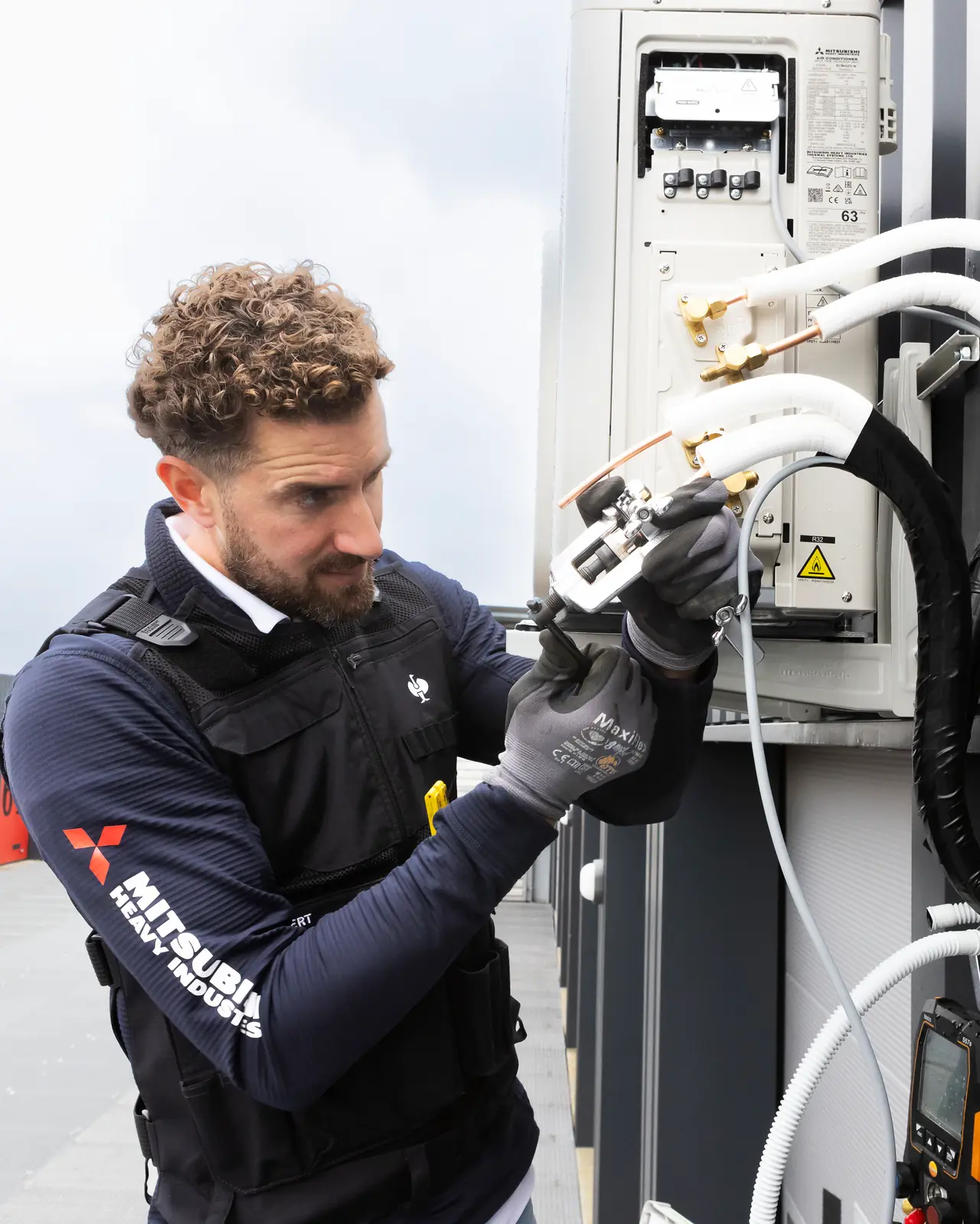
According to the ILT and Milieu Centraal, refrigerant escapes during installation, or through a damaged pipe or connection.
In the photo, Rein is preparing a copper pipe for its connection to an outdoor unit. After any work on the circuit, it should be tested to make sure it's sealed before refrigerant goes in.
WHAT THE TECHNICIAN DOES
How a leak should be dealt with
A certified technician has to be able to do all of this: it's part of their exam.
- 01
Find the leak
Using measuring equipment, they track down where the refrigerant is escaping.
- 02
Fix the leak
They repair the spot where it's leaking. Topping up on its own isn't a repair.
- 03
Test that it's sealed
A pressure test shows whether the circuit is tight, and a vacuum pump draws out air and moisture.
- 04
Fill by weight
Then they put in the right amount of refrigerant, weighed on scales, and write down how much went in.
If your system falls under the legal leak check, from 5 tonnes of CO2 equivalent, a certified technician checks the repair again: after at least a full day of running and within a month.
What you can do yourself
- if it's cooling or heating less than usual, start with the three checks on our breakdown page
- if that doesn't help, call us: measuring the refrigerant is a job for a certified technician
- whenever it's topped up, ask where the leak was, what was done about it and how much refrigerant went in
- ask about the company's and the technician's certificates, and look them up in the Centraal Register Techniek
What you shouldn't do yourself
- buy refrigerant, online or anywhere else
- top it up yourself
- loosen valves, connections or pipes
Just look: don't put your hands or anything else inside the unit.
QUESTIONS
What people ask about topping up
How can I tell if refrigerant is missing?
You can't measure it yourself: a certified technician connects gauges to the circuit for that. If it's cooling or heating less than usual while it's set correctly, the filters are clean and the outdoor unit is clear, give us a call and we'll find out what's going on.
Can air conditioning with R32 or R410A still be topped up?
Yes. Since 1 January 2026, air conditioning can no longer be topped up with new refrigerant that has a GWP of 2,500 or more. R32 is 675 and R410A is 2,088, so that ban doesn't apply to either.
Does my system have to go because refrigerants are being banned?
No. The bans for air conditioning are about selling new equipment, with dates for each type, and about topping up with refrigerant that has a GWP of 2,500 or more. Your existing system with R32 or R410A can stay, and parts for repairs are still allowed. Milieu Centraal does say refrigerant with a high climate impact is getting scarcer and more expensive.
Is topping up included in the maintenance plan?
No, topping up refrigerant and leak detection aren't part of the plan. If it needs doing, you'll always hear first what it is and what it costs.
Can I buy refrigerant and top it up myself?
No. Refrigerant may only be sold to companies and technicians with the right certificate, and working on the circuit is certified work. The ILT warns never to buy refrigerant online: there's a lot of illegal refrigerant around that often isn't right for your equipment.
SOURCES
Where this comes from
- Regulation (EU) 2024/573 on fluorinated greenhouse gasesEUR-Lex
- Implementing Regulation (EU) 2024/2215, Annex I: what a certified technician must be able to doEUR-Lex
- Besluit gefluoreerde broeikasgassen en ozonlaagafbrekende stoffen (Dutch F-gas decree, in Dutch)wetten.overheid.nl
- Tips for consumers on servicing and installing air conditioners and heat pumps (in Dutch)ILT
- Effects of the revised F-gas Regulation for private use and retail (in Dutch)IPLO
- Effects of the revised F-gas Regulation for owners and operators (in Dutch)IPLO
- Air conditioning and fans (in Dutch)Milieu Centraal
- Information for technicians and users of refrigeration, air conditioning and heat pump equipment containing fluorinated greenhouse gasesEuropean Commission
- Find certified companies and technicians (in Dutch)Centraal Register Techniek
All sources accessed on

WHO ANSWERS
Rein Gerritse
Owner, customer contact and installations
Rein owns Airco Holland together with Peter Reijling. Every article includes what he sees in practice, and he checks it before it goes online.
More about Rein and PeterNot cooling like it used to?
Call us and we'll work out what it needs. You'll always hear what it costs first.
READ NEXT
More servicing questions
Why has my air conditioning stopped cooling?
First check for yourself that it's set to cool and lower than the room temperature, that the filters aren't full of dust (switch it off first and just look behind the front cover), and that the outdoor unit is clear and free of ice. If it still won't cool after that, give us a call: some refrigerant may have leaked out, and only a certified technician is allowed to work on the refrigerant.
Is air conditioning maintenance required by law?
No, there's no legal maintenance requirement for an ordinary air conditioning system at home. The only regular check the law requires is a leak check, and that only applies once the refrigerant adds up to 5 tonnes of CO2 equivalent (Article 5, Regulation (EU) 2024/573); a split system with about 1 kilo of R32 comes to 0.675 tonnes, well below that.