Why does my air conditioning smell?
A smelly air conditioner is almost always a dirty one: dirty filters, mould or bacteria on the fins behind the filter, or a dried-out condensation drain. The kind of smell often tells you where to look.
WHAT CAN YOU SMELL?
The smell tells you where to look
This is about a fixed system: an indoor unit in your home and an outdoor unit outside. Find the smell you recognise.
| What you smell | Where it comes from | What to do |
|---|---|---|
| Musty, like damp washing | Moisture and dirt in the indoor unit. Cooling produces condensation, and together with dust, mould can grow on the fins behind the filter and in the drip tray. The air conditioning blows air past it, into your room. | Clean the filters. If you can still smell it afterwards, the dirt goes deeper, and cleaning the inside is a job for the technician. |
| Smoke, perfume or your own home | Air conditioning picks up smells from the room, from smoke, perfume, furniture and clothes, and blows them out again later. | Clean the filters. If the smell keeps coming back, it's inside the unit and a clean will help. |
| Drains | If the condensation drain runs into the sewer, there should be a trap in it that keeps the sewer smell out, often with a little water in it. Water only runs through it when the system is cooling or drying. If you use it for heating, or it's been off for a long time, that water can dry up. | Give us a call and we'll look at the drain. |
| Burning, or anything you don't trust | That's not normal for air conditioning. | Switch it off straight away, cut the power and call us. |
Smell something else and not sure what it is? Start with the filters, and call us if it doesn't go away.
BEHIND THE FILTER
Where the smell comes from
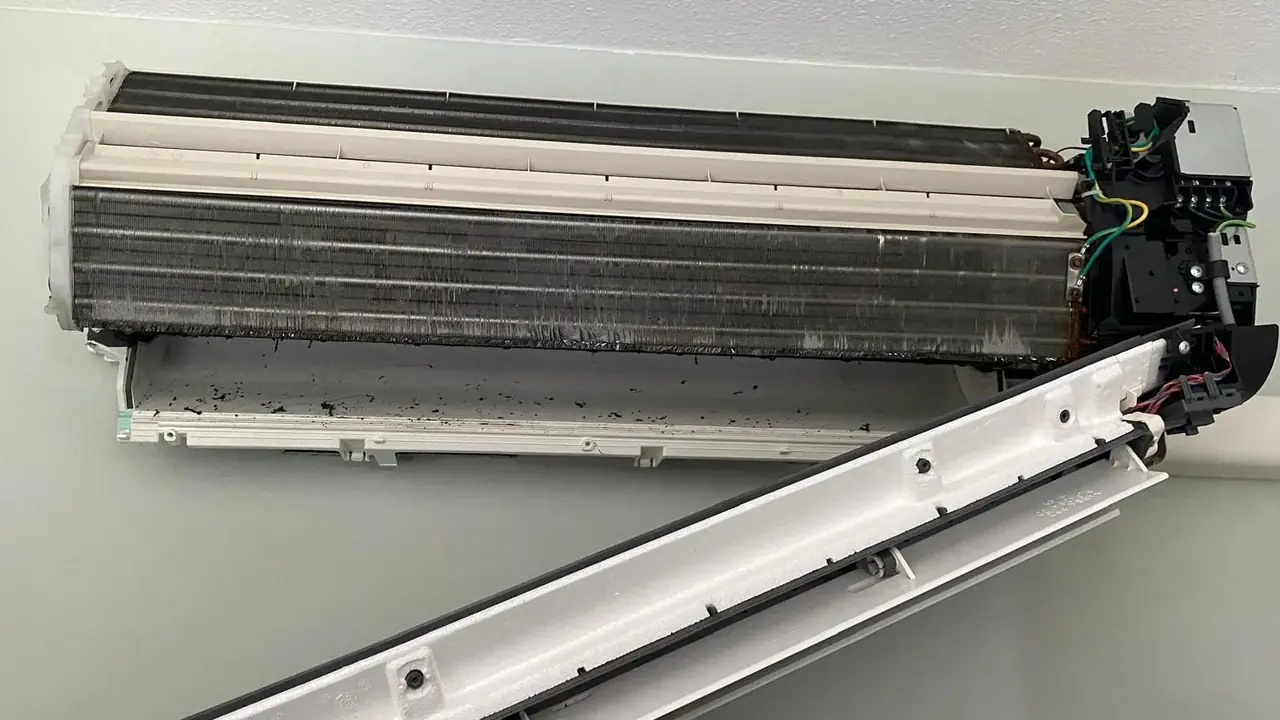
Behind the filter is the evaporator: a block of thin metal fins that the room air flows past. When it's cooling, it gets cold. Moisture from the air settles on it, like on a cold glass, drips into the drip tray (the condensation tray) and runs away through the condensation drain.
Dust that gets past the filter stays behind on those wet fins and in the drip tray. Mould can grow there, and you smell it as soon as the air conditioning blows air past it again.
The manufacturers say so themselves in their manuals: dirty filters and dirt inside the unit can cause an unpleasant smell and mould.
DO IT YOURSELF
Clean the filters
You can do this yourself: manufacturers ask you to in their manuals, and recommend doing it every two weeks while you're using it.
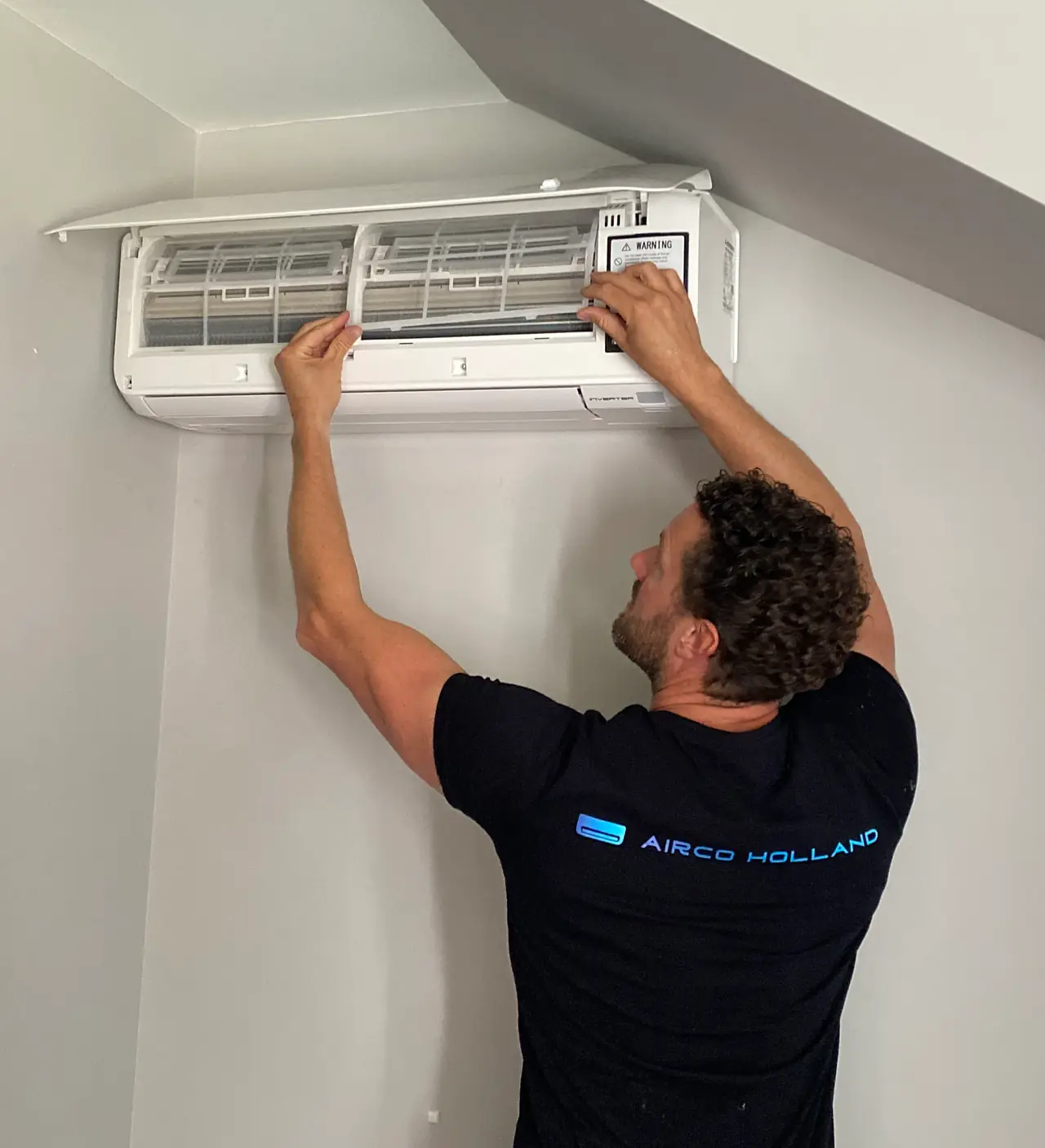
- Switch the air conditioning off with the remote. Wait at least five minutes, then cut the power: unplug it, or switch it off at the fuse box.
- Lift the front cover. Stand on something stable, a step ladder if you need one.
- Take the filters out. Vacuum them or rinse them in lukewarm water, never hot. Don't use cleaning products unless your manual says you can.
- Let them dry in the shade, not in the sun or on a radiator.
- Put them back and close the cover. Never run the air conditioning without its filters.
Don't go any further than the filters. The fins behind them are sharp, and there's a fan inside. Don't spray anything into it either: no cleaning spray, no disinfectant and no air freshener. The wrong product can damage the plastic and cause leaks, and near the electrics it can cause smoke or fire.
A clogged filter lets less air through. The system then cools and heats less well, gets noisier and can use more electricity.
PREVENTION
Let it dry out after cooling
Mould needs moisture. Some air conditioners dry themselves out with the fan after cooling. Mitsubishi Heavy Industries and Mitsubishi Electric call this setting SELF CLEAN. If yours has one, use it.
Not using it for a while, say at the end of the summer? Run it on fan only for a few hours first so the inside dries out, then clean the filters.
That helps against new mould. It won't remove what's already there, as Mitsubishi Heavy Industries points out itself. For that, the inside needs cleaning.
THE TECHNICIAN
Still smells? Then it goes deeper
If it still smells with clean filters, the dirt is somewhere you shouldn't reach yourself: on the evaporator, the fan and in the drip tray. Manufacturers leave cleaning the inside to the technician.
How thorough that needs to be depends on how dirty it is. If it's just a bit dirty, a regular service usually sorts it out. If it goes deeper, it needs an intensive clean or a deep clean. A first indication is when it last had a professional service:
- less than a year ago: a service or an intensive clean
- one to two years ago: an intensive clean
- more than two years ago, or never: a deep clean
Have a look yourself too. Switch the air conditioning off and shine a torch into the air outlet. If you see a lot of dust or dark build-up on the inside or on the fan, it needs more than a regular service.
Don't put your hands or anything else inside: just look.
You'll find what happens in each treatment under servicing and cleaning.
GOOD TO KNOW
You can't smell refrigerant
The refrigerant in your air conditioning usually has no smell. The manufacturers warn about this themselves. So you won't notice a leak by the smell, although the system may start to cool or heat less well.
If you think it's leaking, give us a call. Only a certified technician working for a certified company is allowed to work on the refrigerant. That's set out in Article 10 of the EU F-gas Regulation, and the Dutch Human Environment and Transport Inspectorate explains it (in Dutch).
Sources
- User's manual, air conditioner SRK15ZS-WF to SRK50ZS-WFMitsubishi Heavy Industries Thermal Systems
- Installation manual for indoor unit, SRK wall unitsMitsubishi Heavy Industries
- Operation manual, room air conditioner CTXM-R and FTXM-RDaikin
- User reference guide FTXF-D and ATXF-DDaikin
- Operating instructions MSZ-AY (multilingual)Mitsubishi Electric
- HL drains for air conditioning and ventilation (in German)Hutterer & Lechner
- Siphons (in Dutch)Dyka
- Regulation (EU) 2024/573 on fluorinated greenhouse gases, Article 10EUR-Lex
- Decree on fluorinated greenhouse gases and ozone-depleting substances, Article 4 (in Dutch)wetten.overheid.nl
- Tips for consumers on servicing and installing air conditioners and heat pumps (in Dutch)Human Environment and Transport Inspectorate
All sources accessed on

WHO ANSWERS
Rein Gerritse
Owner, customer contact and installations
Rein owns Airco Holland together with Peter Reijling. Every article includes what he sees in practice, and he checks it before it goes online.
More about Rein and PeterStill smells?
Answer a few questions about your air conditioning, and we'll tell you which treatment fits and what it costs.
READ NEXT
More questions about your air conditioning
Why is my air conditioning leaking water?
Water from the indoor unit is almost always condensation, not refrigerant: usually the condensation drain is blocked or the filters are dirty. If the outdoor unit drips while it's heating, it's usually just defrosting and not broken.
How much does air conditioning servicing cost?
Servicing a system with one wall-mounted indoor unit and one outdoor unit costs €199 a year on a plan, or €210 for a one-off service, including VAT. What you pay depends on how many indoor units you have, the type of air conditioning and how dirty it is.